
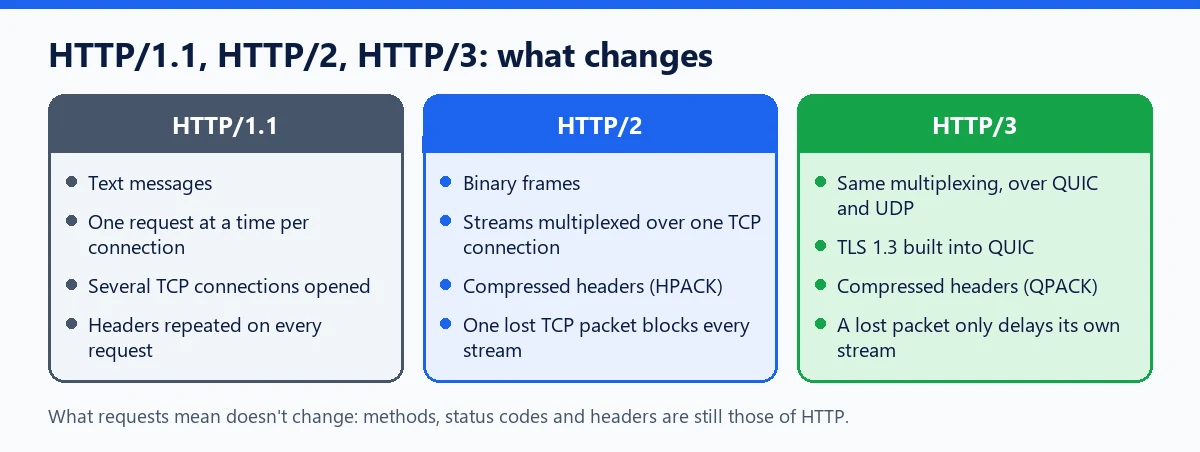
A WordPress page is rarely a single file: there's the HTML, then dozens of stylesheets, scripts, images and fonts. With HTTP/1.1, each connection handles only one request at a time, which forces the browser to open several connections and wait in line. HTTP/2 and then HTTP/3 were designed to carry these many small exchanges more efficiently, without changing what requests mean: methods, status codes and headers stay the same.
HTTP/2: multiplexing
HTTP/2, now specified in RFC 9113 (which obsoletes RFC 7540), splits messages into binary frames. Each exchange becomes a stream, and many streams travel at the same time over a single connection: a slow stream no longer holds up the others. Headers, highly repetitive from one request to the next, are compressed with HPACK.
The RFC acknowledges one limitation: TCP head-of-line blocking isn't solved. If a packet is lost, TCP holds back everything that follows until it's retransmitted, and all streams wait. For HTTP/2 over TLS, the standard requires TLS 1.2 or later, and the Apache documentation notes that most browsers only speak HTTP/2 with https URLs.
HTTP/3: a new transport
HTTP/3 (RFC 9114) keeps the same model, but runs over QUIC (RFC 9000), a secure transport protocol carried in UDP datagrams. QUIC manages streams itself: they are independent, and a loss only delays the stream concerned. TLS 1.3 encryption is part of the handshake, which cuts the number of round trips before the first byte, and a connection can survive a network change, from Wi-Fi to 4G for example. Header compression moves to QPACK.
The browser discovers HTTP/3 through the Alt-Svc header, sent during a first connection over HTTP/2 or HTTP/1.1: it says the same site also answers over h3, on a UDP port. If a firewall blocks UDP, the browser simply stays on HTTP/2.
For WordPress
- Check which version is in use in the Network tab of the browser's developer tools (Protocol column: h2 or h3).
- The easiest route is often a CDN, which speaks HTTP/3 to visitors whatever your server. LiteSpeed offers it too; for Nginx, the HTTP/3 module has been available since version 1.25.0, still described as experimental in its documentation.
- On Apache, HTTP/2 goes through mod_http2 and the
Protocols h2 http/1.1directive; the documentation recommends the event MPM, because with prefork a connection handles only one request at a time. - Open UDP port 443 in the server firewall if you turn on HTTP/3 yourself.
The effect on performance depends on the site, the network and the number of files; the performance signals Google takes into account are discussed in our article on HTTPS, HSTS and security headers.