Site Kit by Google is installed on more than 5 million WordPress sites, and its security history fits in three lines: one critical vulnerability in 2020, then nothing for six years, then two minor vulnerabilities in 2026. A short history, but one worth understanding, because this plugin does not just store settings: it holds the keys to your Google accounts. Here is what happened, what Site Kit actually stores, and how to check that nobody but you controls your Search Console.
Site Kit by Google in brief
Site Kit is Google's official WordPress plugin, available on wordpress.org since October 31, 2019. Its full name sums up what it does: "Analytics, Search Console, AdSense, Speed". It connects the site to Google services, shows their statistics in the Dashboard and can insert the required tags (Analytics, AdSense, ownership verification). It is free, developed as open source on GitHub, and the official directory shows more than 5 million active installations (wordpress.org). At the time of the 2020 vulnerability, it had several hundred thousand.
Its appeal to an attacker is not the number of sites but what it connects. A compromised WordPress site is one problem; a site whose Search Console, statistics or AdSense account is also controlled by a stranger is another, one that extends beyond the site and can go unnoticed.
What Site Kit keeps on your site
To understand why its vulnerabilities matter, you need to know what the plugin stores. According to its source code (version 1.186.0):
- Per-user OAuth tokens: when an administrator signs in with their Google account, Site Kit saves an access token and a refresh token, which let it query Google services on behalf of that account, within the limits of the permissions granted.
- Local encryption: these tokens are encrypted with AES-256 in the database. The key is the
GOOGLESITEKIT_ENCRYPTION_KEYconstant if you have defined it, otherwiseLOGGED_IN_KEYfrom yourwp-config.phpfile. - A site verification token: Site Kit checks with Google that the user connecting it really controls the site, by keeping a verification tag or file associated with that user.
- Sharing settings: since late 2022, an administrator can share a view-only dashboard with other roles (Editor, Contributor...), without those users signing in to Google. Each shared service has an "owner": the person who connected it with their Google account.
Two practical consequences. First, a leak of the database alone does not directly hand over the tokens, but an attacker who also gets wp-config.php holds the key: protect that file and its secret keys like a password. The code even provides a fixed fallback key if no key is defined, with this explicit comment: in that case, "either you're not on a live site, or you have a serious security issue". Second, ownership in Search Console is a broad power. According to Google's help, an owner controls every aspect of the property: users, settings, data and tools. Wordfence pointed out in 2020 that an owner can, among other things, request the removal of URLs from search results or modify sitemaps.
Timeline of vulnerabilities since 2020
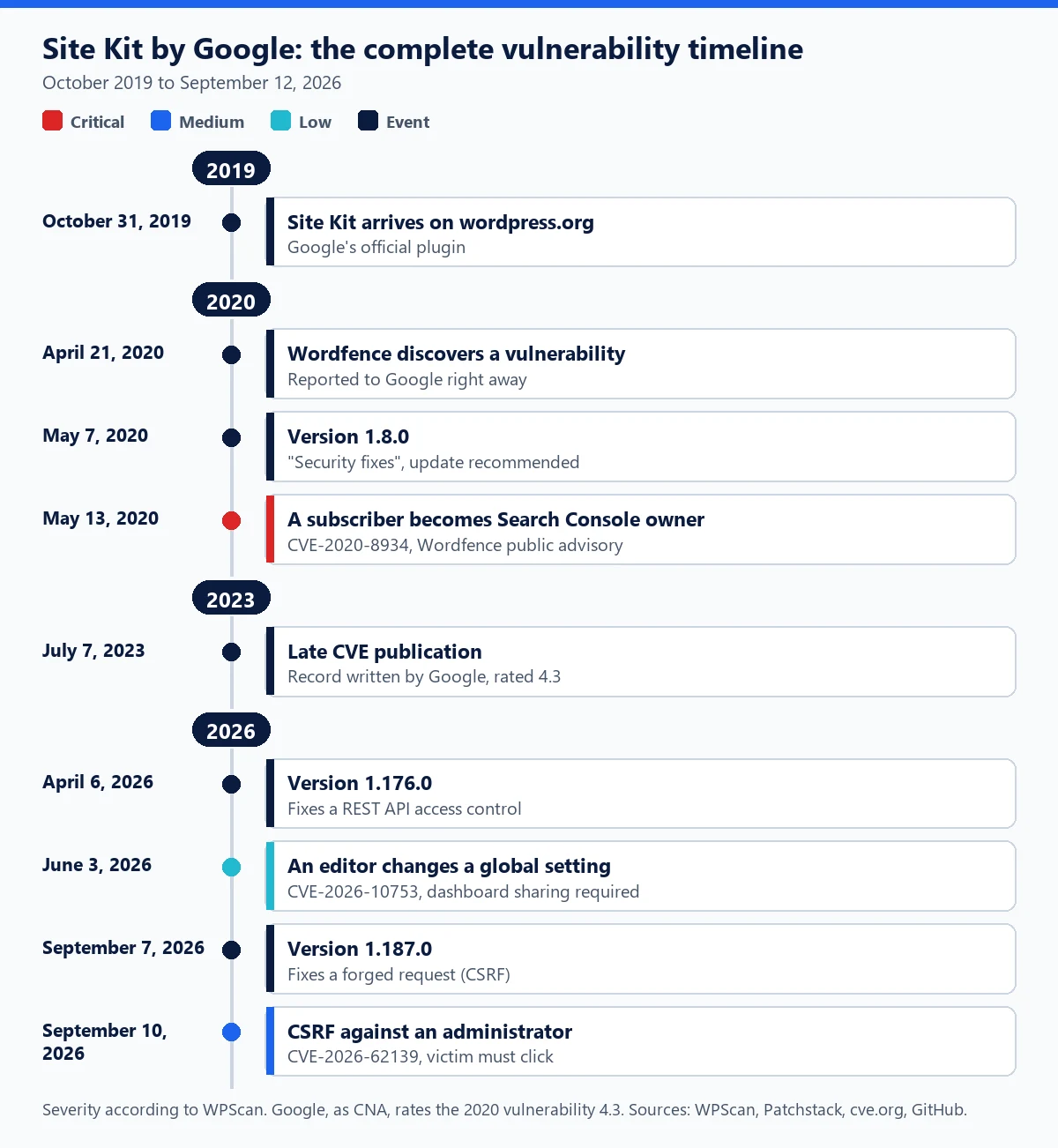
The WPScan and Patchstack databases each list three vulnerabilities for Site Kit, all published between January 1, 2020 and September 12, 2026, and all fixed. None predates 2020.
| Published | Fixed in | Type | CVSS | CVE | Account required |
|---|---|---|---|---|---|
| May 13, 2020 | 1.8.0 | Privilege escalation to Search Console | 4.3 (Google), 9.1 (WPScan) | CVE-2020-8934 | Subscriber |
| June 3, 2026 | 1.176.0 | Missing access control (REST API) | 2.7 (WPScan) | CVE-2026-10753 | Editor with access to the shared dashboard |
| September 10, 2026 | 1.187.0 | Cross-site request forgery (CSRF) | 4.3 (Patchstack) | CVE-2026-62139 | None (an administrator must click) |
The first score is the one from the organization that assigned the CVE (Google, WPScan, Patchstack). The gap for 2020 is explained below. None of the sources consulted documents attacks exploiting these vulnerabilities.
The vulnerabilities explained
May 2020: a subscriber becomes a Search Console owner (CVE-2020-8934)
Chloe Chamberland, a researcher at Wordfence, discovered a chain of two flaws on April 21, 2020. The first: the setup URL used to link the site to Google's authentication service (proxySetupURL) was inserted into the HTML of admin pages without any permission check, so it was visible to any logged-in user, including a mere Subscriber. The second: the admin action that starts the site ownership verification did not check the user's permissions either. Combined, they let a subscriber get registered as an owner of the site's Search Console property.
The consequences described by Wordfence affected SEO more than the site itself: requesting the removal of URLs from Google, viewing performance data, modifying sitemaps. Enough to damage a site's visibility, including at the hands of a competitor. Any site open to public registration (store, forum, membership site) was exposed.
Google released version 1.8.0 on May 7, 2020, just over two weeks after the report. Its release notes simply said: "This release includes security fixes. An update is strongly recommended." Wordfence published its analysis on May 13. According to Security Affairs, more than 100,000 sites had still not updated by that date.
The figures differ depending on the source, and the gap is telling. The CVE record was only published on July 7, 2023, written by Google acting as CNA: it describes an "exposure of sensitive information", rated 4.3 (medium), and lists versions up to 1.8.0 while recommending 1.8.1. WPScan, which scores the full chain up to the Search Console takeover, rates the same vulnerability 9.1 (critical) and considers it fixed in 1.8.0, as does Wordfence. The bottom line: any version 1.8.1 or later is safe on this point.
June 2026: an editor changes a global setting (CVE-2026-10753)
Dashboard sharing opened up a new permission boundary. A CredShields researcher, Shashank, showed that a user with the Editor role who had been given access to the shared dashboard could call a Site Kit REST API endpoint directly and disable the site's email reports, a setting reserved for administrators. Version 1.176.0, released on April 6, 2026, now requires the manage_options capability: the same request is rejected. The public advisory is dated June 3, 2026, nearly two months after the fix. The impact is low (2.7): no data is read, a single setting is changed, and it takes an Editor account to which the administrator has explicitly granted this sharing.
September 2026: a forged request (CVE-2026-62139)
Reported on August 20, 2026 by Ananda Dhakal through Patchstack's bug bounty program, the latest vulnerability is a CSRF: a function did not properly validate its security token (nonce). An attacker without an account could therefore craft a request and trick a logged-in administrator into triggering it, for example by clicking a link. Patchstack does not name the function involved, rates it 4.3 and considers it "unlikely to be exploited". The fix shipped with version 1.187.0 on September 7, three days before the public advisory of September 10.
Why such a short history?
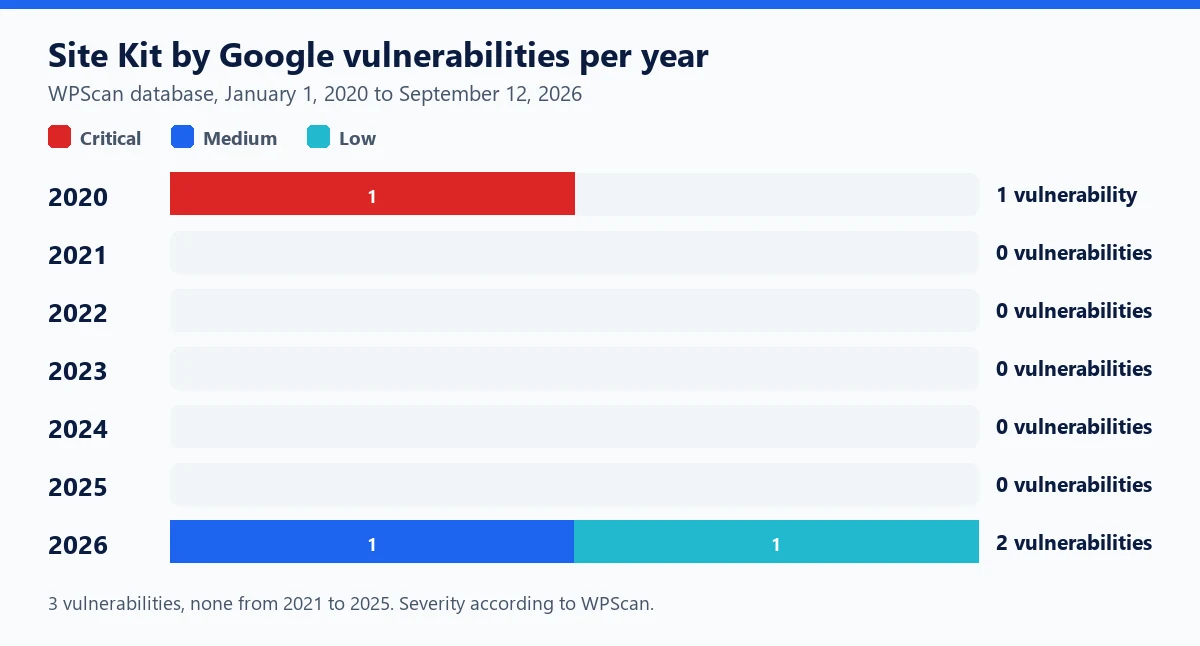
Three vulnerabilities for more than 5 million sites is very few. Google does not publish an explanation, and we will not make one up. We can only note what is observable: Site Kit exposes few functions to anonymous visitors, its code is public on GitHub, and its three known vulnerabilities all concern the same issue, who is allowed to do what in the admin area.
A low count does not prove there are no vulnerabilities: it reflects what has been found and published. The 2020 vulnerability went without a CVE record for more than three years, and Google's release notes did not explicitly flag the 2026 fixes. If you follow your plugins' security through their release notes alone, you can miss things; a vulnerability database or an alert service fills that gap.
What this history shows
- Risk is measured by what the plugin connects: the 2020 vulnerability did not affect the site, but the Google account linked to it, with lasting effects on SEO.
- Low-privilege accounts matter: a Subscriber in 2020, an Editor in 2026. On a site open to registration, every account is a potential entry point (see our article on roles and least privilege).
- New features bring new risks: dashboard sharing, added in late 2022, is the source of the June 2026 vulnerability.
- Fixes often come before the advisory: in 2026, both fixed versions were released before the vulnerabilities were published. A site with automatic updates was protected before they were even known.
- The score depends on who rates it: 4.3 or 9.1 for the same 2020 vulnerability. Also look at the account required and what is actually reached.
To compare with WordPress core, see our timeline of WordPress core vulnerabilities, and for the overall trends, our article on plugin vulnerabilities by the numbers.
How to protect your site
- Update: any version 1.187.0 or later fixes the three vulnerabilities in the table. Site Kit releases frequent, low-risk versions: turn on its automatic updates.
- Check your Search Console owners: in Settings, Users and permissions, remove anyone you do not know. For a verified owner, also remove their verification token, otherwise they can verify ownership again, as Google's help points out.
- Limit dashboard sharing to the roles that really need it, and control who can register on your site.
- Protect
wp-config.php: its secret keys are also used to encrypt Site Kit's Google tokens. - If you no longer use Site Kit, reset it to cut the connection with Google, then delete it (unused plugins).
- Add a web application firewall capable of virtual patching (WAF comparison) and monitor vulnerabilities in your plugins (monitoring plugin vulnerabilities).
WP Feint Pro can help with that last point. Every day, it compares the versions of your installed plugins and themes with the public WPVulnerability.net database and sends you a vulnerability alert by email with the severity and the fixed version, even when the vendor's release notes stay silent. The member area lists pending updates and vulnerable sites (monitoring your sites). WP Feint alerts, it does not fix plugins and it is not a firewall: updating remains the decisive step. Nor does it monitor your Search Console. To round out your toolkit, see our selection of the best WordPress security plugins.
Key takeaways
- Three vulnerabilities published for Site Kit from January 1, 2020 to September 12, 2026, all fixed, no documented attack.
- The most severe, in 2020, let a subscriber become an owner of the site's Search Console (fixed in 1.8.0).
- Minimum recommended version: 1.187.0; install the latest.
- Site Kit keeps access tokens to your Google accounts, encrypted with the keys from
wp-config.php. - Regularly check your Search Console owners and dashboard sharing.
Sources
- Search Console Help: Manage owners, users, and permissions (external link, opens in a new tab)
- GitHub: Site Kit 1.8.0 (May 7, 2020) (external link, opens in a new tab)
- CVE.org: CVE-2020-8934 (July 7, 2023) (external link, opens in a new tab)
- CVE.org: CVE-2026-10753 (June 24, 2026) (external link, opens in a new tab)
Other sources consulted: further CVE records, official vendor pages, trade press articles, WPScan and Patchstack databases.