Figures about WordPress vulnerabilities get shared a lot, often out of context. The two major specialized databases, Patchstack and Wordfence, publish a detailed report every year. This article brings together their most recent figures, explains what they actually measure and turns them into concrete decisions for a site.
Where the figures come from
Patchstack and Wordfence each maintain a WordPress vulnerability database, fed by their researchers and by bug bounty programs. Their totals differ slightly because their scope and validation rules are not identical: for 2024, Patchstack counts 7,966 new vulnerabilities and Wordfence 8,223. Wordfence itself attributes much of the 2024 increase to its bug bounty program launched in late 2023: the more you look, the more you find.
Two consequences for how to read them:
- a rise in the number of published vulnerabilities does not automatically mean that sites are attacked more;
- percentages say more than totals, and it is the real severity (exploitable without an account, already exploited) that matters when deciding.
At the time of writing (October 2026), Patchstack's most recent report covers 2025; Wordfence's latest full annual report covers 2024.
How many vulnerabilities, and where
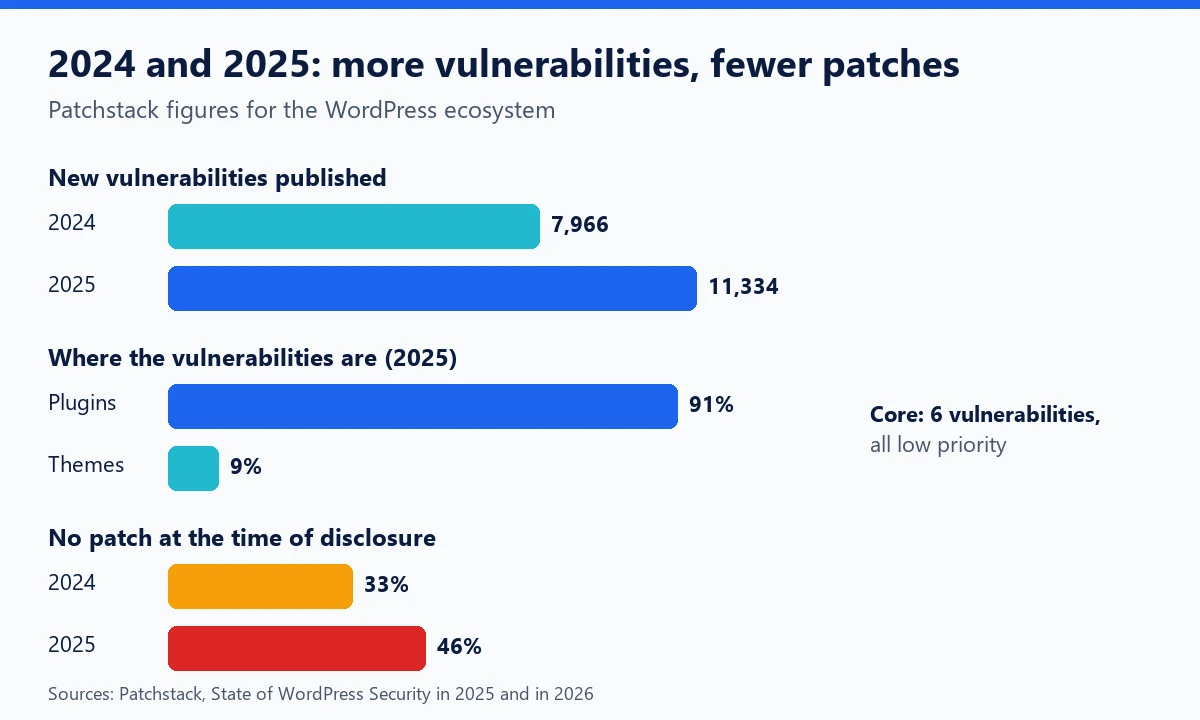
According to Patchstack, the WordPress ecosystem recorded 11,334 new vulnerabilities in 2025, which is 42% more than in 2024. Their distribution is unambiguous:
- 91% in plugins;
- 9% in themes;
- only 6 vulnerabilities in WordPress core, all rated low priority.
For 2024, both reports agree on 96% of vulnerabilities being in plugins (Patchstack and Wordfence), and on a handful in core (7 according to Patchstack, 5 according to Wordfence).
That does not make core invulnerable. In July 2026, WordPress 7.0.2 fixed a chain of two core vulnerabilities (CVE-2026-63030 and CVE-2026-60137, nicknamed "wp2shell") that allowed unauthenticated remote code execution. Versions 6.9.5 and 6.8.6 were released at the same time, and WordPress.org forced the automatic update of affected sites. This episode remains the exception that proves the rule: the statistical risk lies in plugins, but core updates must stay automatic.
Which types of vulnerabilities
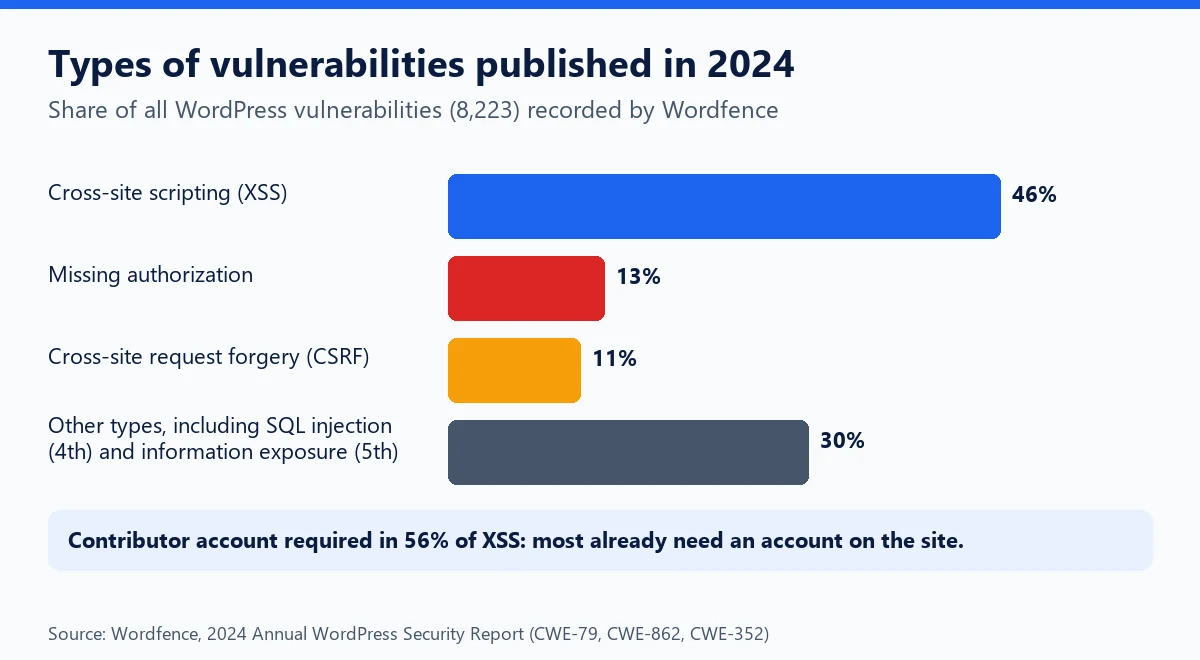
The Wordfence 2024 annual report gives the breakdown by type (CWE classification):
| Rank | Type | Share | What it allows |
|---|---|---|---|
| 1 | Cross-site scripting (XSS) | 46% (3,795 vulnerabilities) | Injecting JavaScript that runs in a visitor's or administrator's browser |
| 2 | Missing authorization | 13% (1,178) | Calling a restricted function without the required role |
| 3 | Cross-site request forgery (CSRF) | 11% (948) | Making a logged-in administrator perform an action without knowing it |
| 4 | SQL injection | not quantified in the summary | Reading or modifying the database |
| 5 | Information exposure | not quantified in the summary | Exposing private content, files or paths |
XSS dominates in volume, but Wordfence adds an important caveat: 56% of the XSS vulnerabilities published in 2024 require a Contributor-level account, and only 5.7% can be exploited with minimal access and without any user interaction. On a site where nobody but you can publish, most of these vulnerabilities are unlikely to be exploited.
Access control vulnerabilities are the ones that matter most in practice. Patchstack reports that Broken Access Control was the most exploited category in 2025. That makes sense: an admin function that can be called without a permission check often makes it possible to create an account, change an option or upload a file.
Severity, patches and speed of exploitation
| Indicator | Value | Source |
|---|---|---|
| Vulnerabilities requiring immediate protection (2025) | 4,124, or 36% | Patchstack |
| High-severity vulnerabilities likely to be mass-exploited (2025) | 1,966, or 17% | Patchstack |
| Vulnerabilities with no patch at the time of disclosure (2025) | 46% | Patchstack |
| High-impact vulnerabilities exploited within 24 hours | Half | Patchstack |
| Weighted median time to first exploitation of the most targeted vulnerabilities | 5 hours | Patchstack |
| 2024 vulnerabilities exploitable without any account | 19% | Wordfence |
| 2024 vulnerabilities in software with fewer than 10,000 installs | 58% | Wordfence |
| Plugins and themes removed from wordpress.org for unpatched vulnerabilities (2024) | 1,614 | Patchstack |
Three lessons stand out.
- Update speed is the deciding factor. When the first exploitation comes within hours, an update done "at the next maintenance window" arrives too late for serious vulnerabilities.
- One vulnerability in two has no patch when it is published (46% in 2025). In those cases, the only options are to deactivate or replace the plugin, or to add a web application firewall rule in the meantime.
- Small plugins account for most vulnerabilities (58% under 10,000 installs), but large ones attract most attacks, because a single exploit reaches millions of sites. The most attacked plugin of 2024 according to Wordfence's firewall rules was LiteSpeed Cache, which has several million installs.
Patchstack also notes that paid or "freemium" components accounted for 29% of valid reports in 2025, with a higher proportion of serious vulnerabilities and three times as many actively exploited vulnerabilities as free components. A paid plugin is therefore not inherently safer.
What to do with this
- Inventory: list your plugins and themes, and delete the deactivated ones (a deactivated plugin can remain exploitable if one of its PHP files can be called directly).
- Automatic updates for widely used, well-maintained plugins, at least for security fixes.
- Monitoring: subscribe to a vulnerability alert source (the Patchstack database, Wordfence Intelligence or WPScan) for your specific plugins.
- Accounts: restrict Contributor and higher roles to the people who need them, which neutralizes most XSS.
- Plugins removed from wordpress.org: a closed plugin no longer receives updates through the Dashboard. Replace it.
With WP Feint
WP Feint does not fix plugin vulnerabilities, and its guide says so explicitly. What it does reduce is what a bot learns about your site: the free version makes plugins' readme and translation files invisible to scanners (on Apache and LiteSpeed), files that often give away the installed versions. The Pro version adds file URL aliases for plugins and themes, the core integrity check and email alerts. A bot that cannot find a plugin's version has a harder time targeting you, but only updating removes the vulnerability.
Key takeaways
- 11,334 new WordPress vulnerabilities in 2025 (+42%), 91% of them in plugins and 6 in core.
- XSS is the most published type (46% in 2024), but most require a Contributor account.
- Broken access control is the most exploited category.
- 46% of vulnerabilities had no patch when they were published in 2025; the most targeted ones are exploited within hours.
- Priorities: inventory, fast updates, targeted alerts and replacing abandoned plugins.
Sources
- Patchstack: State of WordPress Security in 2026 (2025 data) (opens in a new tab)
- Patchstack: State of WordPress Security in 2025 (2024 data) (opens in a new tab)
- Wordfence: 2024 Annual WordPress Security Report (PDF, April 2025) (opens in a new tab)
- WordPress.org: WordPress 7.0.2 Release (July 2026) (opens in a new tab)
Other sources consulted: security research publications.