GPTBot, ClaudeBot, PerplexityBot, Google-Extended, Applebot-Extended: your server logs and robots.txt guides are filling up with new names. Should you block them all to protect your content, or welcome them all to get cited by assistants? Neither, by default. This article separates the crawlers that train models from those that feed live answers, explains what each block costs in visibility, and shows how to limit server load without making yourself invisible.
Three uses, three families of crawlers
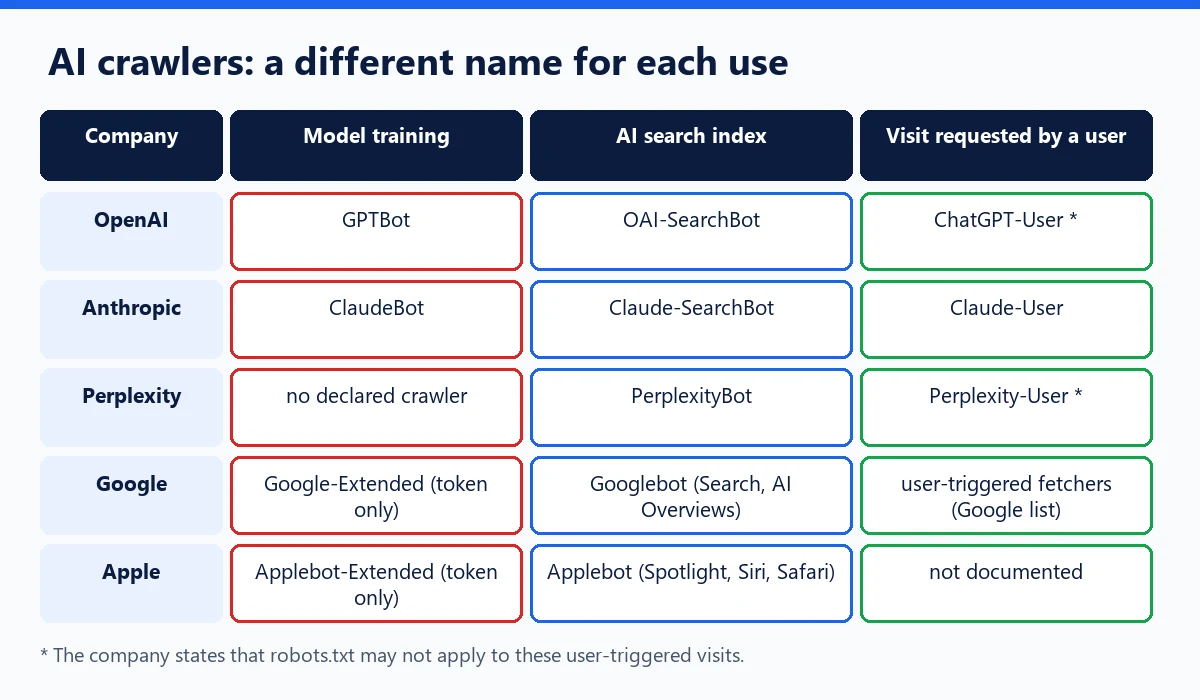
AI companies have gradually split their crawlers according to how the collected pages are used. This split is the key to any decision:
- Training: pages are used to build the training data of future models. Blocking this crawler removes nothing from current answers, and it never sends you a direct visit.
- The AI search index: like a search engine, the crawler explores and indexes so it can cite and link your pages in answers. This is the heart of GEO.
- On-demand visits: a user asks a question and the assistant reads a page live to answer it. This is not automated crawling, which changes the status of robots.txt for some companies.
What the companies say, crawler by crawler
OpenAI
According to OpenAI's documentation, GPTBot is used to make its foundation models more useful and safer; disallowing it signals that the content should not be used for training. OAI-SearchBot is used to surface websites in ChatGPT's search features. ChatGPT-User covers actions triggered by a user, for which OpenAI warns that robots.txt rules may not apply. OpenAI says it takes about 24 hours after a robots.txt change for its search systems to adjust, and it publishes the list of IP addresses for each crawler.
Anthropic
Anthropic's help center (article dated April 7, 2026) describes ClaudeBot, which collects content that may contribute to training, Claude-SearchBot, which improves the quality of search results, and Claude-User, which fetches a page when a user asks a question. Anthropic states that its crawlers respect robots.txt, support the non-standard Crawl-delay extension and do not try to bypass CAPTCHAs. It spells out the effects of a block: restricting ClaudeBot excludes future content from training, whereas blocking Claude-SearchBot or Claude-User may reduce your visibility in answers.
Perplexity
PerplexityBot is used to surface and link websites in Perplexity's results and, according to its documentation, it is not used to train foundation models. Perplexity-User visits a page at a user's request and, since the request comes from a person, generally ignores robots.txt rules. Both IP address lists are published in JSON.
Google-Extended is not a crawler but a robots.txt token: it has no user agent of its own, and crawling is done by Google's usual crawlers. It controls whether content is used to train Gemini models and for grounding in the Gemini apps and Vertex AI. Google states that it has no effect on inclusion in Search and is not a ranking signal.
AI Overviews and AI Mode, on the other hand, rely on Googlebot and the Search index: you control them with nosnippet, max-snippet or noindex and, since August 31, 2026, with the "Search generative AI control" setting in Search Console, rolled out to all sites. Opting out removes links and content from these features, usually within a few days, and deprives the site of the traffic they bring, without acting as a signal for the rest of Search; it does not, however, cover training, which falls under Google-Extended.
Apple
Applebot powers search features in Spotlight, Siri and Safari, among others, and its data may also be used to train Apple's foundation models. Applebot-Extended crawls no pages: it is a name to use in robots.txt to opt out of training without leaving Apple's search results. An important detail Apple points out: if robots.txt does not mention Applebot but does mention Googlebot, Applebot follows the rules written for Googlebot. Applebot does not read Crawl-delay but slows down on its own if the site responds slowly or with errors.
| Name | Stated use | robots.txt | Effect of a block |
|---|---|---|---|
| GPTBot | Training (OpenAI) | Respected | Content excluded from training |
| OAI-SearchBot | Search in ChatGPT | Respected | Less presence in ChatGPT search |
| ChatGPT-User | Visit requested by a user | May not apply | Uncertain |
| ClaudeBot | Training (Anthropic) | Respected, Crawl-delay read | Future content excluded from training |
| Claude-SearchBot | Search in Claude | Respected | Reduced visibility in answers |
| Claude-User | Visit requested by a user | Respected | Claude can no longer read the page on demand |
| PerplexityBot | Perplexity results | Respected | Absent from Perplexity results |
| Perplexity-User | Visit requested by a user | Generally ignored | Low |
| Google-Extended | Gemini training and grounding | Token only | No effect on Google Search |
| Applebot-Extended | Training (Apple) | Token only | No effect on Apple's search |
The effect on your visibility in AI
The mechanism is simple: an assistant can only cite and link what its search crawler was able to read, or what it can go and read on demand. Blocking OAI-SearchBot, Claude-SearchBot or PerplexityBot therefore means giving up on being a source for those answers. Blocking GPTBot, ClaudeBot, Google-Extended or Applebot-Extended, on the other hand, does not stop you from appearing in them, according to these companies' documentation: that choice is about training, not citation.
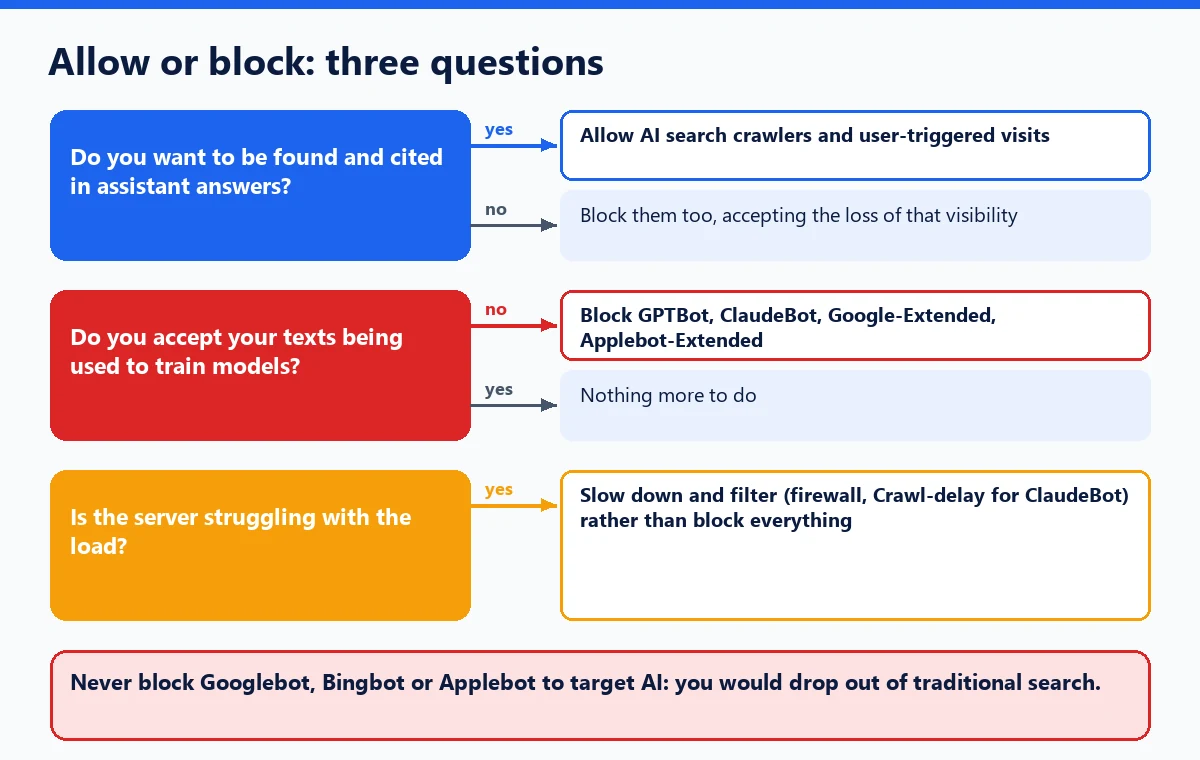
Allowing search crawlers does not guarantee you will be cited, though: it only makes citation possible. The rest depends on the quality and relevance of the content, just as with traditional SEO. The most costly trap lies elsewhere: blocking Googlebot, Bingbot or Applebot to "block AI", which takes the site out of traditional search itself.
A robots.txt that accepts search and refuses training looks like this:
# Training: refused
User-agent: GPTBot
Disallow: /

User-agent: ClaudeBot
Disallow: /

User-agent: Google-Extended
Disallow: /

User-agent: Applebot-Extended
Disallow: /

# Traditional search and AI search: allowed
User-agent: *
Allow: /
Disallow: /wp-admin/
Allow: /wp-admin/admin-ajax.php

Sitemap: https://www.example.com/wp-sitemap.xml
Adapt the Sitemap line to your site and, before publishing, check that Googlebot and Applebot are not caught by a restrictive rule.
Server load, a real issue
On shared hosting, crawlers that go through thousands of URLs (store filters, archives, internal searches) can slow the site down for real visitors. Cloudflare reported in July 2026 that training accounted for 52% of AI crawler requests observed on its network in June 2026, compared with 22% in spring 2025. Before blocking anything, look at your logs: which crawler, which URLs, how often. Then:
- Close infinite spaces (internal search, filter combinations) to all crawlers rather than blocking an entire crawler.
- Use Crawl-delay for crawlers that read it, such as ClaudeBot. Google does not support this field, and neither does Applebot.
- Turn on page caching: a page served from cache costs little, whoever the visitor is.
- Filter at network level undeclared or abusive crawlers, with a web application firewall or a CDN.
robots.txt is not a barrier
robots.txt is a convention: Cloudflare's documentation points out that compliance is voluntary and that it does not technically prevent access to content. In August 2025, Cloudflare accused Perplexity of using undeclared crawlers, with a browser user agent and other IP addresses, on test domains that disallowed crawling. Two practical consequences:
- A user agent name proves nothing. Any script can claim to be GPTBot or Googlebot. Check the IP address: reverse DNS lookup for Google, JSON lists published by OpenAI and Perplexity.
- For an effective ban, you need a block at server or CDN level. Since September 15, 2026, Cloudflare has replaced its former "Block AI Bots" toggle with three independent settings (search, agents, training) and generates a managed robots.txt with content signals. Choose the training option carefully: according to Cloudflare, "Disallow AI Training" lets Googlebot, Bingbot and Applebot crawl for search and blocks the other training crawlers, whereas "Block" also stops those three crawlers, search included.
If your site runs behind Cloudflare, also remember to restore visitors' real IP address on the WordPress side, otherwise your logs and rate limits see every crawler behind the same addresses: see our article on Cloudflare and the real IP.
AI crawlers and attack bots: do not lump them together
Declared AI crawlers read your public pages. Attack bots look for wp-login.php, xmlrpc.php, .env files or backups, and do not read robots.txt out of courtesy. Treating them the same way leads to bad decisions: blocking useful crawlers out of fear, or ignoring dangerous probes because they pose as a search engine. Our article on bots, scanners and logs explains how to tell them apart.
WP Feint targets the second category. The bot traps count requests to addresses that do not exist on your site but that attack tools look for (sensitive files, paths of the imitated software, closed WordPress addresses), without ever counting a real page. The Pro version adds a log, automatic banning after several traps and Cloudflare support so the right address gets banned. The plugin does not manage your policy toward AI crawlers: that choice stays in robots.txt and your CDN.
Bots, from AI companies and search engines alike, also download your images: optimised files lighten that load (see the best plugins to optimise images).
Read also: MCP in WordPress: what the Model Context Protocol changes and how to make the most of it.
Key takeaways
- Separate three decisions: training, AI search, on-demand visits.
- Refusing training (GPTBot, ClaudeBot, Google-Extended, Applebot-Extended) does not remove you from answers, according to the companies.
- Blocking AI search crawlers means giving up on being cited there; allowing them guarantees no citation.
- Never block Googlebot, Bingbot or Applebot to target AI.
- robots.txt is voluntary: for load and abuse, filter at server or CDN level.
Sources
- OpenAI, Overview of OpenAI Crawlers (opens in a new tab)
- Anthropic, crawlers and how to block them (April 7, 2026) (opens in a new tab)
- Perplexity, Perplexity Crawlers (opens in a new tab)
- Google, common crawlers and Google-Extended (updated October 15, 2026) (opens in a new tab)
Other sources consulted: official documentation and official vendor pages.