Hello Elementor, Kadence, GeneratePress, Neve and the Twenty Twenty-X default themes run on millions of sites, and yet WPScan attributes no published vulnerability to them since 2020. This is neither luck nor a guarantee: these themes contain little server-side code, and their advanced features live in companion plugins which, for their part, have a well-filled history. Here are the figures, the reasons for this calm and the vulnerabilities of those plugins.
The themes studied in brief
Installation figures come from wordpress.org, which rounds them into tiers:
- Hello Elementor (Elementor): more than one million active installations. The vendor describes it as a "lightweight and minimalist" theme designed to serve as a base for the Elementor builder.
- Kadence (StellarWP, published under the Nexcess account): more than 500,000 active installations, on wordpress.org since November 2020.
- GeneratePress (Tom Usborne): more than 500,000 active installations; according to its theme page, a fresh install adds less than 10 KB gzipped to a page's weight.
- Neve (Themeisle): more than 200,000 active installations, presented as a theme with lightweight code.
- The WordPress default themes: Twenty Twenty-Five (more than one million), Twenty Twenty-Four (500,000), Twenty Twenty-Three (300,000), Twenty Twenty-One and Twenty Twenty (200,000 each), Twenty Twenty-Two (100,000).
A theme is loaded on every page: a vulnerability in a theme present on a million sites would be a windfall for attack bots. The absence of vulnerabilities therefore deserves to be checked, not assumed.
How many vulnerabilities in these themes since 2020?
We checked each theme's entry in WPScan and Patchstack. The figures cover the period from January 1, 2020 to June 27, 2026; for the themes at zero, no entry exists before 2020 either.
| Theme | Active installations | WPScan vulnerabilities | Patchstack vulnerabilities | Details |
|---|---|---|---|---|
| Hello Elementor | 1 million+ | 0 | 1 | CVE-2024-31289, cross-site request forgery (CSRF), CVSS 4.3, fixed in 3.0.1 |
| Kadence | 500,000+ | 0 | 0 | No entry |
| GeneratePress | 500,000+ | 0 | 0 | No entry |
| Neve | 200,000+ | 0 | 0 | No entry |
| Twenty Twenty-Five | 1 million+ | 0 | 0 | No entry |
| Twenty Twenty-Four | 500,000+ | 0 | 0 | No entry |
| Twenty Twenty to Twenty Twenty-Three | 100,000 to 300,000 | 0 | not checked | No entry in WPScan |
The only vulnerability on record concerns Hello Elementor up to version 3.0.0. Published on April 12, 2024 by Patchstack, which rated it 4.3 out of 10, it let an attacker get a logged-in administrator to perform an action by making them open a booby-trapped link, with limited impact. Reported by Dhabaleshwar Das (Patchstack Alliance), it was fixed in 3.0.1. No exploitation is documented.
A word of caution: an empty database entry means that no vulnerability has been published, not that the code is flawless. And the databases do not always match: WPScan did not pick up the Hello Elementor entry published by Patchstack.
Why these themes have so few vulnerabilities
This calm is not specific to these few themes. In its report on 2025, Patchstack recorded 11,334 new vulnerabilities in the WordPress ecosystem: 91% in plugins and 9% in themes. Several reasons explain the gap.
Little code that receives data
A vulnerability almost always stems from data sent to the server and processed without checks: an AJAX action, a REST API route, a form, a file import. A presentation theme contains very little of that. The recent default themes go further: Twenty Twenty-Two to Twenty Twenty-Five are block themes. The official WordPress documentation explains that such a theme relies on HTML templates made of blocks and on a theme.json file for settings and styles; only style.css and templates/index.html are required, with the PHP functions.php file being optional. Less PHP handling requests means less attack surface.
The wordpress.org directory rules
All the themes studied are distributed through wordpress.org, which requires a review before publication. The Themes Team requirements state that "the theme must be secure", that untrusted data must be validated and sanitized before going into the database, then escaped before output. Above all, they prohibit features unrelated to presentation: analytics, SEO options or contact forms fall within "plugin territory". Nor can a theme install a plugin automatically: installation must come from a user action.
Advanced features move into plugins
To comply with these rules, and as a business choice, vendors move rich features into companion plugins. Kadence demo sites go through Kadence Starter Templates, Neve's through the "Starter Sites & Templates by Neve" plugin; advanced blocks are in Kadence Blocks, GenerateBlocks or Otter Blocks; GeneratePress's paid modules in the GP Premium plugin; Hello widgets in Hello Plus, which requires a theme from the Hello family. And Hello Elementor is only useful with Elementor, whose vulnerability history is traced in our timeline of Elementor vulnerabilities.
Partly a matter of visibility
According to Patchstack, paid components get less attention from researchers, since their code is not easy to access. The themes studied are free and heavily scrutinized, which makes their record fairly reassuring; for the paid parts (GP Premium, Pro versions), an empty entry proves even less.
The companion plugins do have vulnerabilities
This section is no longer about the themes but about plugins from the same vendors: a site that uses Kadence without Kadence Blocks is not affected by their vulnerabilities. Counts are WPScan's, from January 1, 2020 to June 27, 2026, supplemented when a vulnerability documented elsewhere is missing from WPScan.
| Theme | Companion plugin | Active installations | Vulnerabilities (WPScan) | Notable vulnerability |
|---|---|---|---|---|
| Kadence | Kadence Blocks | 600,000+ | 33, plus 1 published by Patchstack | Unauthenticated file upload, August 2023, no CVE; CVE-2023-6964 (SSRF, 8.5) |
| Kadence | Kadence Starter Templates | 200,000+ | 1 | CVE-2022-3679 (PHP object injection, administrator) |
| GeneratePress | GP Premium (paid) | not published | 1, plus 1 published by Wordfence | CVE-2024-3469 (reflected XSS, 6.1); CVE-2023-6807 (stored XSS, 6.4) |
| GeneratePress | GenerateBlocks | 200,000+ | 7 | Medium or low vulnerabilities, all with a contributor account |
| Neve | Otter Blocks | 300,000+ | 12 | CVE-2023-2288 (PHAR); CVE-2026-2892 (purchase bypassed without an account, 7.5) |
| Neve | Starter Sites & Templates by Neve | 100,000+ | 1 | CVE-2023-47529 (log file readable without an account, 5.3) |
| Hello Elementor | Hello Plus | 70,000+ | 0 | None; Elementor itself is covered separately |
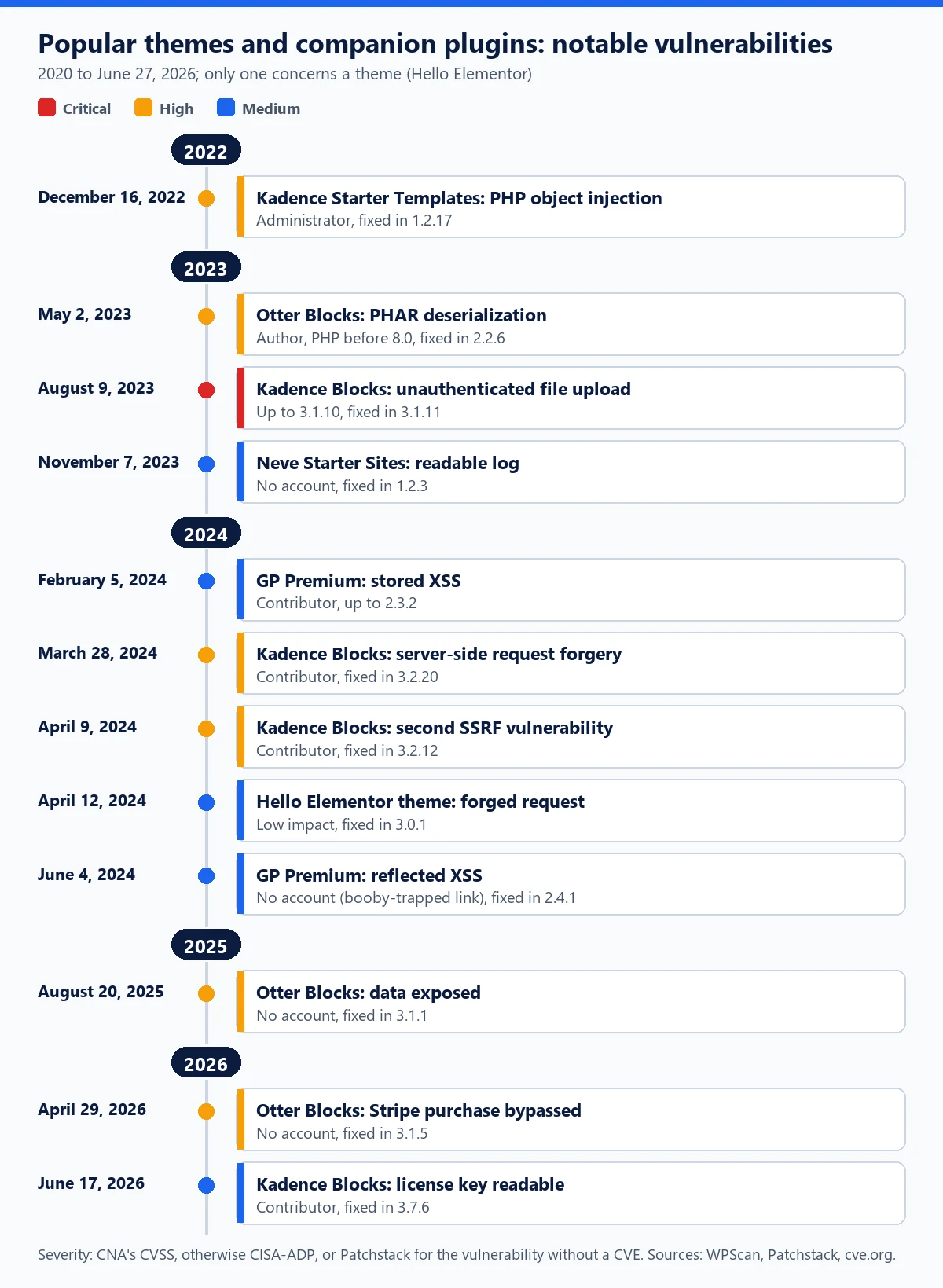
The plugins' notable vulnerabilities explained
Kadence Blocks: an unauthenticated file upload in 2023
On August 9, 2023, Patchstack published an arbitrary file upload vulnerability in Kadence Blocks up to version 3.1.10, exploitable without an account and rated 10 out of 10. An attacker could drop a file of their choice on the server, enough to take it over. Version 3.1.11 fixed it. This vulnerability has no CVE number and does not appear in WPScan's list, which shows why it pays to cross-check the databases.
Kadence Blocks: the server used as a relay
In 2024, two server-side request forgery (SSRF) vulnerabilities hit the plugin. The more severe, CVE-2023-6964, rated 8.5 by Wordfence, went through the kadence_import_get_new_connection_data AJAX action: a contributor could force the server to send requests to any address, including internal services that are normally unreachable. Reported to the vendor on December 19, 2023 by Lucio Sá, it was published on April 9, 2024; WPScan lists it as fixed in 3.2.12. The second, CVE-2024-23500 (7.7 according to Patchstack, discovered by Rafie Muhammad), was fixed in 3.2.20. WPScan also counts 23 Kadence Blocks vulnerabilities in 2024, mostly stored XSS reachable by a contributor.
In 2026, CVE-2026-11357, published on June 17, 2026, let a contributor read in the browser console the Kadence license key, the license holder's email address and the API key connected by the administrator; version 3.7.6 fixed it. These vulnerabilities require an account (see roles and least privilege).
Kadence Starter Templates and Otter: deserialization
Kadence Starter Templates before 1.2.17 unserialized the content of an imported file (CVE-2022-3679, published by WPScan on December 16, 2022): an administrator who imported a booby-trapped file could trigger a PHP object injection if an exploitable "gadget" chain existed on the site. Otter Blocks before 2.2.6 had a related flaw (CVE-2023-2288, discovered by Alex Sanford): an author could pass a phar:// path to file operations, with deserialization on PHP versions earlier than 8.0. Both are rated 8.8 by CISA-ADP. Our article on deserialization and PHP object injection details this mechanism.
Otter Blocks: vulnerabilities without an account
Otter Blocks, the block plugin from Themeisle, Neve's vendor, has two high-severity vulnerabilities exploitable without an account. CVE-2025-55715 (7.5 according to Patchstack, fixed in 3.1.1 in August 2025) exposed sensitive data. CVE-2026-2892 (7.5 according to Wordfence) targeted sites that sell access through the Stripe payment block: the plugin trusted an unsigned cookie, o_stripe_data, to know whether the visitor had bought a product. By forging this cookie with the product ID, visible in the page code, a visitor could display the restricted content without paying. Reported on February 20, 2026 by Drew Webber, it was published on April 29, 2026 and fixed in 3.1.5.
GP Premium and the Neve Starter Sites
GP Premium, GeneratePress's paid plugin, has had two XSS: a stored one, reachable by a contributor through custom metadata up to 2.3.2 (CVE-2023-6807, published on February 5, 2024), and a reflected one up to 2.4.0, which required getting someone to click a booby-trapped link (CVE-2024-3469, fixed in 2.4.1 in June 2024). The "Starter Sites & Templates by Neve" plugin, up to 1.2.2, left a log file readable by anyone (CVE-2023-47529, discovered by Joshua Chan, fixed in 1.2.3). The XSS mechanism is explained in our article on XSS vulnerabilities.
None of these vulnerabilities is documented as exploited by a recognized source.
What these figures show
- Risk follows features, not the theme's name: a "bare" Kadence or Neve site exposes very little code; the same site with three companion plugins exposes their AJAX actions, their REST routes and their imports.
- Block plugins pile up contributor XSS: every block attribute displayed without escaping is a potential door, hence the dozens of entries for Kadence Blocks and Otter Blocks.
- Severe vulnerabilities remain rare but do exist: unauthenticated file upload (Kadence Blocks, 2023), payment bypass (Otter, 2026).
- Zero vulnerabilities does not mean zero updates: WordPress core has its own rhythm of security releases, traced in our timeline of core vulnerabilities.
How to protect your site
- Take inventory: the active theme and all its plugins (blocks, templates, Pro version) form the set to monitor.
- Update the theme and its companions, at a minimum Kadence Blocks 3.7.6, Otter Blocks 3.1.5, Kadence Starter Templates 1.2.17, GP Premium 2.4.1 and Hello Elementor 3.0.1, ideally their latest version. GP Premium requires an active license to update.
- Turn on automatic updates for minor releases (our guide to automatic updates).
- Deactivate and then delete template plugins once the site is imported: Kadence Starter Templates or the Neve Starter Sites are no longer useful after the import (see abandoned and unused plugins).
- Limit contributor and author accounts: most block plugin vulnerabilities require one.
- Add a web application firewall to cover the gap between a disclosure and your update (our WordPress firewall comparison), and watch the advisories that concern your components (our method).
WP Feint Pro helps you not miss an advisory, for plugins as well as themes. Every day, it compares the installed versions with the public WPVulnerability.net database and sends a vulnerability alert by email with the severity and the fixed version; the member area shows pending updates and vulnerable sites. WP Feint alerts: it does not fix plugins and it is not a firewall, so updating remains essential. For a firewall, see our comparison of the best WordPress security plugins.
Read also: How to choose a WordPress theme: 7 criteria and a scoring grid.
Key takeaways
- WPScan lists no vulnerability from 2020 to June 27, 2026 for Hello Elementor, Kadence, GeneratePress, Neve and the Twenty Twenty to Twenty Twenty-Five themes; Patchstack counts one, minor, in Hello Elementor (fixed in 3.0.1).
- Reasons: little code that handles requests, block themes, wordpress.org rules that push features into plugins.
- The companion plugins do have vulnerabilities: 33 in WPScan for Kadence Blocks, 12 for Otter Blocks, including some without an account.
- Monitor and update the theme and all its plugins, and delete template plugins after the import.
Sources
- WordPress.org, Themes Team: Required (review requirements) (external link, opens in a new tab)
- WordPress Developer Resources: Theme Structure (external link, opens in a new tab)
- CVE.org: CVE-2023-6964, Kadence Blocks, SSRF (April 9, 2024) (external link, opens in a new tab)
- CVE.org: CVE-2022-3679, Starter Templates by Kadence WP (January 9, 2023) (external link, opens in a new tab)
Other sources consulted: further CVE records, WPScan and Patchstack databases.