

The principle is simple: you expose something no legitimate user has any reason to touch. Any interaction with that bait is suspicious by nature, which gives a signal with almost no false positives. The IETF Internet Security Glossary (RFC 4949) describes a honeypot as a system or resource designed to be attractive to potential crackers and intruders, “like honey is attractive to bears.”
The different types of honeypots
- Network or server honeypot: an isolated machine that imitates a vulnerable service (SSH, database, web server). Researchers and security teams use them to observe attackers' tools and methods.
- Low or high interaction: a low-interaction honeypot only simulates the surface of a service; a high-interaction honeypot offers a real system, which yields more information but is riskier if poorly isolated.
- Trap URL on a website: a URL that only bots request, such as
/.env,/phpmyadminor/administrator/on a site that isn't running Joomla!. - Trap field in a form: a field hidden with CSS that humans don't see but spam bots fill in. The submission is then discarded without showing a CAPTCHA.
How a bot trap works
Attack bots sweep the internet with lists of well-known URLs: forgotten configuration files, admin tools, login pages of other CMSs. A site that has none of these URLs can turn them into sensors. The response stays an ordinary 404 error, but every request is counted. Past a threshold, the IP address can be blocked for a while: a human doesn't fall into several traps in a row, a scanner does.
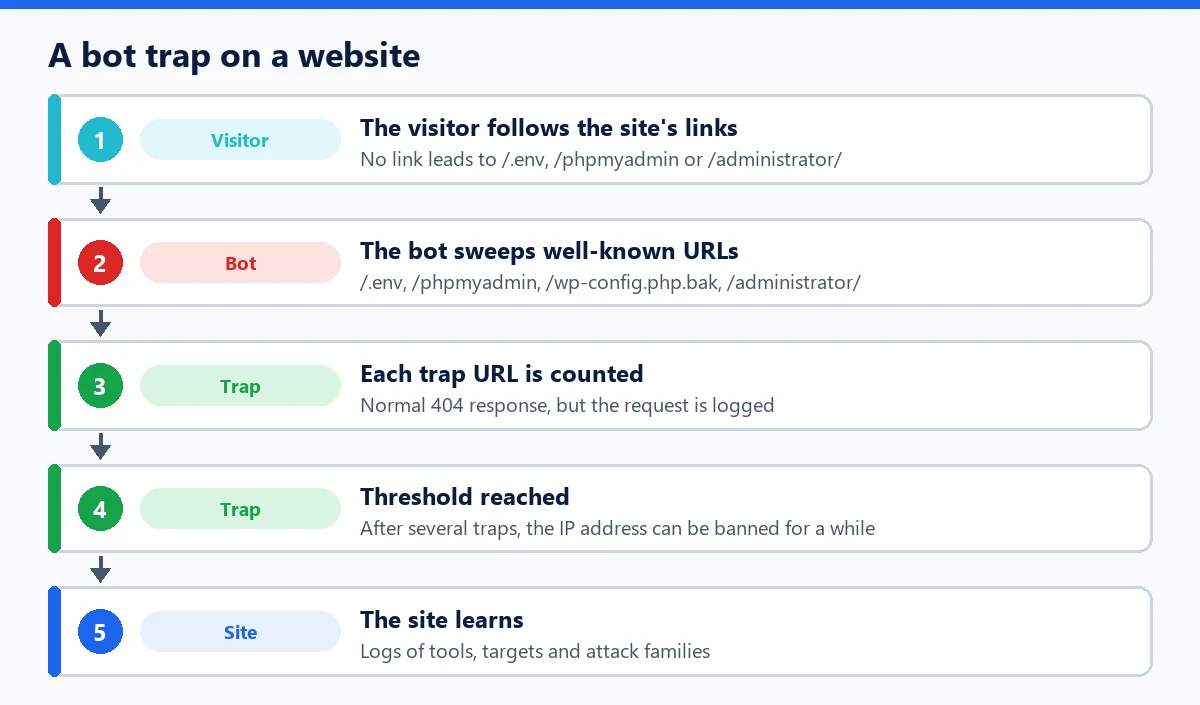
To know which URLs to watch, the easiest way is to read your own logs: our article on scanner bots in server logs covers the most frequent requests and how to respond to them.
For WordPress
On a WordPress site, the most telling traps are the URLs you closed yourself: wp-login.php after moving the login page, xmlrpc.php once XML-RPC is blocked, /?author= when user enumeration is shut off. A bot that keeps hitting these URLs is almost always preparing a brute-force attack.
- Never ban on a single trap: a broken link or an audit tool can trigger a false positive.
- Behind a CDN or a proxy, make sure the real visitor IP address is restored, otherwise everyone shares the proxy's address.
- Mention the logs in your privacy policy and limit how long you keep them.
Limitations
A honeypot detects bots and can keep them out, but it doesn't fix any vulnerability. An attacker going straight for a known vulnerable plugin has no need to touch a trap URL. Nor does it replace a web application firewall or protection against distributed attacks.
The WP Feint Bot traps module counts bots by family for free (flaws of the imitated CMS, sensitive files, closed WordPress URLs). The Pro version adds banning after a chosen number of traps (three recommended), a 30-day log with truncated IP addresses and fake Joomla! and Drupal login pages. Pages already in cache are still served to a banned bot.