{
"title": "Fingerprinting",
"seo_title": "Fingerprinting: definition and the clues WordPress leaks",
"h1": "Fingerprinting",
"description": "Fingerprinting identifies the CMS, its version and its plugins. The clues bots read, WordPress examples and the limits of hiding them.",
"lead": "Fingerprinting means identifying the software that runs a website, its version and its components from visible clues: HTTP headers, the generator tag, file paths, cookies. Bots use it to pick which known vulnerabilities to try on each site.",
"language": "en",
"locale": "en-US",
"type": "definition",
"url": "https://www.wp-feint.com/glossary/fingerprinting/",
"canonical": "https://www.wp-feint.com/glossary/fingerprinting/",
"markdown": "https://www.wp-feint.com/glossary/fingerprinting/index.md",
"json": "https://www.wp-feint.com/glossary/fingerprinting/index.json",
"published": "2026-10-28T08:00:00+00:00",
"modified": "2026-11-22T12:07:22+00:00",
"site": {
"name": "WP Feint",
"url": "https://www.wp-feint.com/"
},
"translations": [
{
"language": "en",
"hreflang": "en-US",
"title": "Fingerprinting",
"url": "https://www.wp-feint.com/glossary/fingerprinting/",
"markdown": "https://www.wp-feint.com/glossary/fingerprinting/index.md",
"json": "https://www.wp-feint.com/glossary/fingerprinting/index.json"
},
{
"language": "fr",
"hreflang": "fr-FR",
"title": "Fingerprinting",
"url": "https://www.wp-feint.com/fr/definitions/fingerprinting/",
"markdown": "https://www.wp-feint.com/fr/definitions/fingerprinting/index.md",
"json": "https://www.wp-feint.com/fr/definitions/fingerprinting/index.json"
},
{
"language": "es",
"hreflang": "es-ES",
"title": "Fingerprinting",
"url": "https://www.wp-feint.com/es/glosario/fingerprinting/",
"markdown": "https://www.wp-feint.com/es/glosario/fingerprinting/index.md",
"json": "https://www.wp-feint.com/es/glosario/fingerprinting/index.json"
},
{
"language": "de",
"hreflang": "de-DE",
"title": "Fingerprinting",
"url": "https://www.wp-feint.com/de/glossar/fingerprinting/",
"markdown": "https://www.wp-feint.com/de/glossar/fingerprinting/index.md",
"json": "https://www.wp-feint.com/de/glossar/fingerprinting/index.json"
},
{
"language": "it",
"hreflang": "it-IT",
"title": "Fingerprinting",
"url": "https://www.wp-feint.com/it/glossario/fingerprinting/",
"markdown": "https://www.wp-feint.com/it/glossario/fingerprinting/index.md",
"json": "https://www.wp-feint.com/it/glossario/fingerprinting/index.json"
},
{
"language": "pt",
"hreflang": "pt-BR",
"title": "Fingerprinting",
"url": "https://www.wp-feint.com/pt/glossario/fingerprinting/",
"markdown": "https://www.wp-feint.com/pt/glossario/fingerprinting/index.md",
"json": "https://www.wp-feint.com/pt/glossario/fingerprinting/index.json"
},
{
"language": "nl",
"hreflang": "nl-NL",
"title": "Fingerprinting",
"url": "https://www.wp-feint.com/nl/woordenlijst/fingerprinting/",
"markdown": "https://www.wp-feint.com/nl/woordenlijst/fingerprinting/index.md",
"json": "https://www.wp-feint.com/nl/woordenlijst/fingerprinting/index.json"
}
],
"headings": [
{
"level": 1,
"text": "Fingerprinting"
},
{
"level": 2,
"text": "How fingerprinting works"
},
{
"level": 2,
"text": "Examples on WordPress"
},
{
"level": 2,
"text": "How to reduce your fingerprint"
},
{
"level": 2,
"text": "For WordPress"
}
],
"body": "Fingerprinting is almost always the first step of an automated attack. Before trying anything, a bot wants to know what it is dealing with: WordPress, Joomla! or Drupal, which version, which plugins. This sorting lets it choose, from its list of known vulnerabilities, the ones with a chance of working, and skip sites that don't match. The OWASP Web Security Testing Guide (WSTG) devotes a separate chapter of the information gathering phase to it.\n\n## How fingerprinting works\n\nDetection tools compare what the site returns with a database of signatures. OWASP mentions several families of clues:\n\n- **HTTP headers**, such as `X-Powered-By` or `X-Generator`;\n- **cookies**, whose name often gives away the software (`wordpress_logged_in_…`);\n- **the HTML code**: comments, the `` tag, software-specific paths;\n- **well-known files and folders**, tested one by one;\n- **error messages** that reveal paths or the platform.\n\nTools such as WhatWeb, Wappalyzer and WPScan automate this work. A bot needs only a few requests to classify a site.\n\n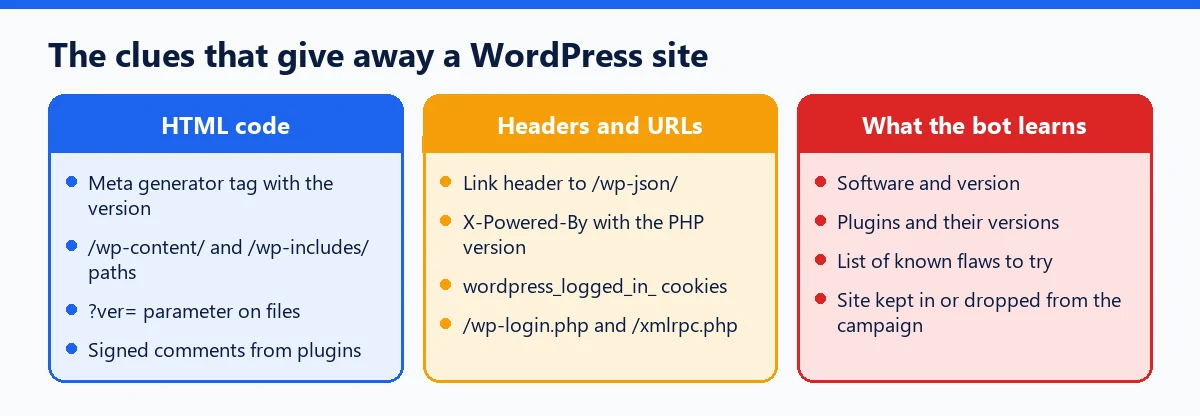\n\n## Examples on WordPress\n\nA standard WordPress site is recognized very quickly. The `get_the_generator()` function outputs the `` tag in pages and an equivalent in RSS and Atom feeds, version included. Stylesheets and scripts carry the `/wp-content/` and `/wp-includes/` paths followed by a `?ver=` parameter. The `Link` header announces the REST API, and many SEO, caching and page builder plugins sign the page code with a comment that gives their name and version. Our article [on how bots and Wappalyzer recognize WordPress](https://www.wp-feint.com/wordpress-fingerprinting-detection/) reviews these signatures one by one.\n\n*Video: “Fingerprint Web Apps & Servers for Better Recon [Tutorial]” (Null Byte)*\n\n## How to reduce your fingerprint\n\n- Remove the generator tag and the [HTML comments left by plugins](https://www.wp-feint.com/html-comments-generator-tag-wordpress/).\n- Remove `X-Powered-By` (`expose_php = Off` in PHP) and make the `Server` header less talkative, as OWASP recommends for [response headers](https://www.wp-feint.com/glossary/http-security-headers/).\n- Remove unnecessary technical links (RSD, shortlinks) and close the URLs you don't use, such as [XML-RPC](https://www.wp-feint.com/glossary/xml-rpc/).\n\nStay clear-eyed: OWASP files these measures under security through obscurity. They slow down the least sophisticated bots and reduce noise, but a determined attacker eventually identifies the software. They complement updates without ever replacing them: a vulnerable plugin stays vulnerable, whether it is visible or not. The article [Hiding WordPress: what it does and what it doesn't](https://www.wp-feint.com/hiding-wordpress-benefits-limits/) sorts it all out.\n\n## For WordPress\n\nWP Feint targets exactly these clues. The free version removes the WordPress mention, the comments and generator tags of known plugins and some [technical links](https://www.wp-feint.com/features/wordpress-technical-links/); it can also [make the site pass for another CMS](https://www.wp-feint.com/features/cms-imitation/), so that bots try attacks that have no target there. The plugin's guide spells out its limits: the imitation adds the best-known clues of the announced software, it doesn't reproduce it in full, and a header may be missing on a page served by an upstream cache.\n\n## Related terms\n\n- [HTTP security headers](https://www.wp-feint.com/glossary/http-security-headers/)\n- [XML-RPC](https://www.wp-feint.com/glossary/xml-rpc/)\n- [Honeypot](https://www.wp-feint.com/glossary/honeypot/)\n- [CVE](https://www.wp-feint.com/glossary/cve/)\n- [User enumeration](https://www.wp-feint.com/glossary/user-enumeration/)\n\n\n## Sources\n\n- [OWASP WSTG : Fingerprint Web Application Framework](https://wstg.owasp.org/latest/4-Web_Application_Security_Testing/01-Information_Gathering/08-Fingerprint_Web_Application_Framework)\n- [WordPress Developer Resources : get_the_generator()](https://developer.wordpress.org/reference/functions/get_the_generator/)\n- [OWASP : HTTP Security Response Headers Cheat Sheet](https://cheatsheetseries.owasp.org/cheatsheets/HTTP_Headers_Cheat_Sheet.html)",
"definition": "Fingerprinting means identifying the software that runs a website, its version and its components from visible clues: HTTP headers, the generator tag, file paths, cookies. Bots use it to pick which known vulnerabilities to try on each site.",
"group": "Web security",
"aka": [
"web fingerprinting",
"CMS detection",
"technology detection",
"software fingerprinting"
],
"related": [
{
"title": "HTTP security headers",
"url": "https://www.wp-feint.com/glossary/http-security-headers/",
"markdown": "https://www.wp-feint.com/glossary/http-security-headers/index.md"
},
{
"title": "XML-RPC",
"url": "https://www.wp-feint.com/glossary/xml-rpc/",
"markdown": "https://www.wp-feint.com/glossary/xml-rpc/index.md"
},
{
"title": "Honeypot",
"url": "https://www.wp-feint.com/glossary/honeypot/",
"markdown": "https://www.wp-feint.com/glossary/honeypot/index.md"
},
{
"title": "CVE",
"url": "https://www.wp-feint.com/glossary/cve/",
"markdown": "https://www.wp-feint.com/glossary/cve/index.md"
},
{
"title": "User enumeration",
"url": "https://www.wp-feint.com/glossary/user-enumeration/",
"markdown": "https://www.wp-feint.com/glossary/user-enumeration/index.md"
}
],
"sources": [
{
"title": "OWASP WSTG : Fingerprint Web Application Framework",
"url": "https://wstg.owasp.org/latest/4-Web_Application_Security_Testing/01-Information_Gathering/08-Fingerprint_Web_Application_Framework"
},
{
"title": "WordPress Developer Resources : get_the_generator()",
"url": "https://developer.wordpress.org/reference/functions/get_the_generator/"
},
{
"title": "OWASP : HTTP Security Response Headers Cheat Sheet",
"url": "https://cheatsheetseries.owasp.org/cheatsheets/HTTP_Headers_Cheat_Sheet.html"
}
],
"format": "application/json"
}